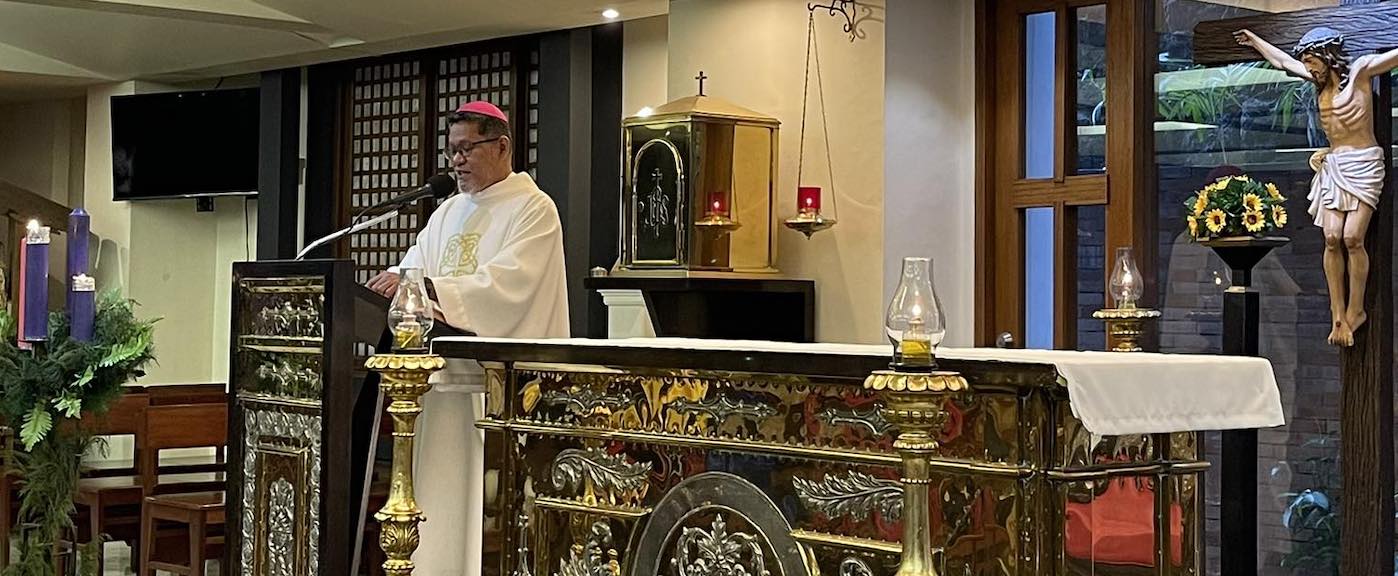
Archbishop-elect Rex Andrew Alarcon of Caceres. NIKKO BALBEDINA/CBCP NEWS
By Roy Lagarde February 22, 2024 Manila, Philippines
Pope Francis on Thursday appointed Bishop Rex Andrew Alarcon as the new archbishop of Caceres, his home archdiocese.
Alarcon, currently serving as the bishop of Daet, will succeed Archbishop Rolando Tria Tirona, who retired at the age of 77.
Tirona has led the archdiocese since November 2012.
As archbishop of Caceres, Alarcon will oversee the pastoral care of Catholics in Naga City, considered the economic, cultural, educational, and religious center of the Bicol region.
The archbishop-elect was born in Daet, the provincial capital of Camarines Norte, on August 6, 1970.
After completing his high school education and philosophy courses at the Holy Rosary Minor Seminary in Naga, he studied theology at the University of Santo Tomas (UST) Central Seminary in Manila.
Alarcon was ordained a priest for the Archdiocese of Caceres on November 9, 1996.
The 53-year-old also holds a licentiate in Church history, which he obtained from the Pontifical Gregorian University in Rome in 2001.
Before becoming a bishop, he led the Bicol Association of Catholic Schools and served as the president of the Catholic Educational Association of the Philippines (CEAP).
On Jan. 2, 2019, the pope appointed him as the bishop of Daet. He was ordained to the episcopate on March 19 of the same year and formally assumed his new role the following day.
As metropolitan archbishop, he also meets with the suffragan bishops to discuss matters of importance to the region. The suffragan dioceses of the Caceres archdiocese include Daet, Legazpi, Libmanan, Masbate, Sorsogon and Virac.
Within the Catholic Bishops’ Conference of the Philippines (CBCP), Alarcon currently serves as the chairman of the Episcopal Commission on Youth.
It was a show of our Conviction to defend life from conception to natural death.
A reigniting of our Commitment – if you can wake up before the sunrise, walk down a highway to a program in a field – that’s commitment to a reignited cause!
And a strengthening of Community. Regardless of Arch/Diocese, Organization or affiliation, we all came together to be a Community of disciples towards a goal.
Thank you to all who made this possible. We are so blessed and thankful. Never imagined this, but like I said, we go where the Lord takes us, and we do what He wants us to do!
Jose F. Cardinal Advincula University of Santo Tomas, Manila February 17, 2024
Rev. Fr. Filemon dela Cruz, Prior Provincial of the Dominican Province of the Philippines; Rev. Fr. Richard Ang, O.P., university rector; my dear Dominican fathers and brothers; administrators, faculty, personnel, and students of the university; dearly beloved in Christ,
Together, we walk for life.
This is the theme we have chosen for our Walk for Life 2024. We want to highlight the fact that in life, we cannot walk alone. As we uphold, promote, and defend the sacredness of life and the dignity of every person, we cannot be alone. We need one another. We need to journey together. An African proverb tells us, “If you want to go fast, go alone. If you want to go far, go together.” Indeed, our defense and promotion of a culture of life in our society today is not a short-term engagement or a temporary battle. From experience, we know that as long as there are subtle and not so subtle attacks against the family and human life, we will be there to register our firm objection and make sure that our united stand is heard.
Today, I would like to honor and appreciate all of you who have been at the forefront of our mission to proclaim the Gospel of Life, a message lovingly received day after day by the Church and preached with dauntless fidelity as good news to the people of every age and culture. For some of you, this has been your life-long task and advocacy. Thanks to all of you, missionaries for the Gospel of Life, we can fulfill our prophetic role in a rapidly changing world that is oftentimes more welcoming to a civilization of death and so hostile to a civilization of life and love. I encourage you to continue to be passionate in your ministry. Do not be disheartened if sometimes you feel that what you have been doing is not even noticed or ends up in an apparent failure. Take courage. You are not alone. As the prophet Isaiah said in the first reading, “The Lord will guide you alwaysand give you plenty even on the parched land.He will renew your strength,and you shall be like a watered garden,like a spring whose water never fails.”
The theme “Together, we walk for life,” is also a challenge for us to explore new pathways to respond better to the dominant values of our contemporary times. Kailangan na rin nating harapin ang katotohanan na napakaraming isyu sa pamilya at lipunan ngayon ang hindi na maaaring sagutin ng “Huwag ka nang magtanong. Sumunod ka na lang.” We need to engage in more listening and dialogue. This is part of walking for life. Yes, we are clear about our teachings on the different issues connected with life and family. But we also need to rethink our approaches, methodologies, and strategies. How do we deal with the dilemmas and complexities of modern families, the irregular situations in the home, the diversity in understanding identity and personhood, the wounds caused and inflicted because of polarization even in the home? Pope Francis has pointed us to the style of synodality so we can listen and discern together. It is important that all of us here in this walk must help each other to become a synodal Church in mission.
Jesus, in our Gospel today from St. Luke, gave us the best example of how to walk for life together. He dined and dialogued with the known sinners of His time. He called Levi, a tax collector, to follow Him. He attended the banquet which Levi prepared in his house. He had no problem being on the same table with a large crowd of tax collectors! He told the scribes and pharisees who were complaining about his impertinent behavior, “Those who are healthy do not need a physician, but the sick do.
When our God reveals himself, his message is always one of freedom: “I am the Lord your God, who brought you out of the land of Egypt, out of the house of slavery” (Ex 20:2). These are the first words of the Decalogue given to Moses on Mount Sinai. Those who heard them were quite familiar with the exodus of which God spoke: the experience of their bondage still weighed heavily upon them. In the desert, they received the “Ten Words” as a thoroughfare to freedom. We call them “commandments”, in order to emphasize the strength of the love by which God shapes his people. The call to freedom is a demanding one. It is not answered straightaway; it has to mature as part of a journey. Just as Israel in the desert still clung to Egypt – often longing for the past and grumbling against the Lord and Moses – today too, God’s people can cling to an oppressive bondage that it is called to leave behind. We realize how true this is at those moments when we feel hopeless, wandering through life like a desert and lacking a promised land as our destination. Lent is the season of grace in which the desert can become once more – in the words of the prophet Hosea – the place of our first love (cf. Hos 2:16-17). God shapes his people, he enables us to leave our slavery behind and experience a Passover from death to life. Like a bridegroom, the Lord draws us once more to himself, whispering words of love to our hearts.
The exodus from slavery to freedom is no abstract journey. If our celebration of Lent is to be concrete, the first step is to desire to open our eyes to reality. When the Lord calls out to Moses from the burning bush, he immediately shows that he is a God who sees and, above all, hears: “I have observed the misery of my people who are in Egypt; I have heard their cry on account of their taskmasters. Indeed I know their sufferings, and I have come down to deliver them from the Egyptians, and to bring them up out of that land to a good and broad land, a land flowing with milk and honey” (Ex 3:7-8). Today too, the cry of so many of our oppressed brothers and sisters rises to heaven. Let us ask ourselves: Do we hear that cry? Does it trouble us? Does it move us? All too many things keep us apart from each other, denying the fraternity that, from the beginning, binds us to one another.
During my visit to Lampedusa, as a way of countering the globalization of indifference, I asked two questions, which have become more and more pressing: “Where are you?” (Gen 3:9) and “Where is your brother?” (Gen 4:9). Our Lenten journey will be concrete if, by listening once more to those two questions, we realize that even today we remain under the rule of Pharaoh. A rule that makes us weary and indifferent. A model of growth that divides and robs us of a future. Earth, air and water are polluted, but so are our souls. True, Baptism has begun our process of liberation, yet there remains in us an inexplicable longing for slavery. A kind of attraction to the security of familiar things, to the detriment of our freedom.
SANGGUNIANG LAIKO NG PILIPINAS 23rd Biennial National Convention October 27-29, 2023
RESOLUTIONS
We, the 299 participants representing the 28 Lay Organizations and Movements (LOMAS) and the 37 Arch/Diocesan Councils of the Laity are gathered during the 23rd National Biennial Convention of the Sangguniang Laiko ng Pilipinas held on October 27 to 29, 2023 in Tacloban City in the Diocese of Palo with the theme: ‘United in Mission as a Synodal Church’ which is held in time of the Synod on Synodality at the Vatican.
It is the first time the participants from all over the Philippines are gathered face to face after the pandemic caused by Covid-19 virus.
INTEGRAL FORMATION
As lay members of the Church, we are aware of the urgency to provide an integral, integrated formation for different age levels, cultures, languages, social classes, gender, etc. We are called to provide structures and spaces for this endeavor emphasizing the spiritual, doctrinal, and social dimensions, we resolve to:
Deepen our relationship with God through prayer, contemplation, and silence that disposes a discerning and listening heart in all our activities and gatherings.
Provide a common integral formation program on the role of the laity in the Church through the Apostolic Exhortation, Christi Fideles Laici that is made available for all Lay Organizations and Movements (LOMAS) and Arch/Diocesan Councils of the Laity.
CO-RESPONSIBILITY
We recognize that we all called to serve through the gifts we receive from the Holy Spirit. Each one has equal opportunity to serve for the mission. As lay, we need to find ways on how we can complement and not to compete with each other. We can only do this if we know who we are and where we are coming from, we resolve to:
Foster an environment of open dialogue and collaboration between lay and clergy for the fulfillment of the mission of the Church through listening, respecting each other and walking together.
Promote affective collegiality among members of the Church to bring about a sense of owning in its activities and life.
Journey together as a synodal Church with its structures of better listening that all voices are heard and valued.
2. INCLUSION
A great challenge of a synodal Church today is a desire to be converted from our own pre-judgements and see things in the eyes of God; to be firm in our faith, to do what we believe and be able to respect others. We are convinced that dialogue is a way of building bridges to break boundaries that divide and foster unity in the midst of differences, we resolve to:
Reach out and welcome everyone in the community; journeying with them in the different teachings and sharing our faith life experience.
Provide opportunities of participation and engage in the mission of the Church, the young people, those who are considered to be in the peripheries, and those with special needs.
Collaborate with people of other faith, Christian groups and denominations, and indigenous people in addressing our common concerns like working for peace, care for our common home, pursuit for good governance, and alleviation of poverty.
All these, we entrust into the hands of God with Mary as our icon of synodality to accompany us, as we commit ourselves, dedicate our time, and economic resources for the fulfillment of these resolutions in the next two years.
Every month the Sangguniang Laiko ng Pilipinas releases this Online Newsletter – Laity’s News – which features highlights from the activities of Laiko.
Archbishop Emeritus Fernando Capalla of Davao. DAVAO CATHOLIC HERALD
By Fr. Sebastiano D’Ambra, PIME January 7, 2024 Manila, Philippines
The news of the death of Archbishop Fernando Capalla on January 6 , 2024, who died at the age of 89 is a time of sorrow for all of us and for me also an occasion to remember him as a good friend who contributed a lot for the promotion of interreligious dialogue in Mindanao and on the national and international level.
When I started the Silsilah Dialogue Movement in 1984, he was happy of this new beginning to the point that when he was elected as chairperson of the Catholic Bishops’ Conference of the Philippines (CBCP) for the Commission on Interreligious Dialogue he asked me to be the executive secretary and allow me to have the office in Zamboanga near the office of Silsilah.
This great sign of trust and friendship helped me a lot to be challenged more in the mission that I started in dialogue with the Muslims in Zamboanga and along the years in Mindanao and on the national level.
Silsilah invited Archbishop Capalla in Zamboanga for some seminars and for the summer course. He was also with us the day that Fr. Salvatore Carzedda, PIME was killed in Zamboanga City on May 20, 1992. I can also recall a critical moment when in Davao I was rushed to the hospital and he helped me in many ways.
I believe many of us can say many things about the goodness and generosity of archbishop Capalla. I think he is well known for starting the Bishops Ulama Forum that after a few years was renamed as Bishops’ – Ulama Conference. I was at his side as executive secretary of the CBCP for the Commission on Interreligious Dialogue. I remember the first gathering in Cebu in 1996 and the many other gatherings in the different parts of Mindanao and Manila. For two occasions we also did the gathering of the Bishops-Ulama Conference in Harmony Village, Zamboanga City.
Our friendship was expressed in many ways and he was an honorary member of the Board of Trustee of Silsilah, he encouraged me to continue the dream to start the Emmaus Dialogue Community in Zamboanga. In that occasion as chairman of the Episcopal Commission for Interreligious Dialogue of the CBCP he wrote: “The diocesan bishop is advised by the new Code of Canon Law:’to discern the new gifts of the consecrated life which the Holy Spirit entrusted to the Church (C.605). The Emmaus Dialogue Community is a new form of consecrated life in the local Church.’ I believe that this new community is a gift and a blessing to the local Church and to the Church at large. With dialogue as its primary objective it answers a long-felt need in this Church’s Ministry.”
Guided by this spirit and friendship with the new Emmaus Dialogue Community that after was renamed Emmaus Dialogue Community opening the charism to all in the Church, Archbishop Capalla volunteered to be the patron bishop of this new reality of Emmaus in the Church and was very happy when during one of my visits in Davao I shared to him that Emmaus Dialogue Movement is ground on and we opened an Emmaus College of Theology, major on Interreligious Dialogue.